How to Read a Magic: The Gathering Card
Every Magic card follows the same layout. Once you know where to look, you can understand a card you have never seen in a few seconds.
Take the tour
Tap any part of the card, or start the tour to go through the parts in reading order.
Pick a part
Tap anything on the card
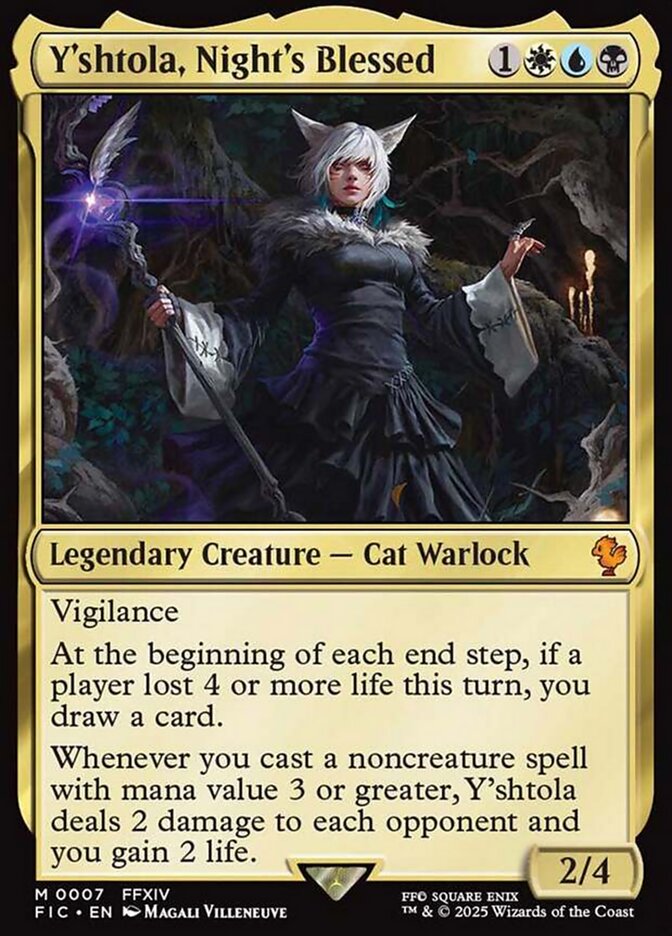
This is Y'shtola, Night's Blessed from Final Fantasy Commander. Each part you can tap is one every card has. The tour walks through them in the order you would read a card you have never seen.
Name (top left)
The card's name. Rules that refer to “a card named X” care about this exact text. Some cards have two names separated by a double slash, like modal double-faced cards or split cards. Those are one card with two halves.
Mana cost (top right)
The symbols in the top right tell you what you pay to cast the card. A number in a grey circle is generic mana and can be paid with any color. Colored symbols must be paid with that specific color. A card with no mana cost, like most lands, can't be cast normally; lands are played instead.
Add up every symbol to get the card's mana value. A card costing two generic plus one green has a mana value of three. Mana value matters for a lot of effects, like counterspells that only hit cheap spells or cards that search for one with a certain mana value.
Art
The picture doesn't affect gameplay, but it does affect price. The same card printed with different art, a special frame, or a foil finish can cost many times more than the plain version. If you only care about playing the card, the cheapest printing works exactly the same.
Type line (middle)
Below the art is the type line. It has up to three parts:
- Supertype, like Legendary or Basic
- Card type, like Creature, Instant, Sorcery, Artifact, Enchantment, Land, Planeswalker, or Battle
- Subtype, after the dash, like Elf Warrior or Aura
The type line tells you how and when the card can be played. Instants can be cast almost any time. Sorceries only on your turn when nothing else is happening. Creatures and other permanents stay on the battlefield after you cast them.
Set symbol and rarity (right side of the type line)
The small symbol next to the type line identifies which set the card came from. Its color tells you the rarity:
| Color | Rarity |
|---|---|
| Black | Common |
| Silver | Uncommon |
| Gold | Rare |
| Orange-red | Mythic rare |
Rarity has no effect on gameplay. It affects how many copies exist, which is the main reason prices differ between cards.
Rules text (text box)
This is what the card actually does. A few things to know:
- Keywords like Flying, Trample, or Deathtouch are shorthand for longer rules. The keyword glossary explains each one.
- Reminder text in italics and parentheses explains a keyword. It is not part of the rules, just a help.
- Flavor text in italics with no parentheses is story text and does nothing.
- “You” means the card's controller. “Target” means you pick something when the spell or ability goes on the stack.
Power and toughness (bottom right, creatures only)
The two numbers separated by a slash. Power is how much damage the creature deals. Toughness is how much damage it can take before it dies. Planeswalkers have a loyalty number here instead, and battles have a defense number. The combat basics guide shows both numbers at work in a fight.
Collector info (bottom left)
The fine print at the bottom shows the collector number, set code, artist name, and copyright line. The collector number and set code together identify a single printing. This is what price tools use to tell a 2015 printing apart from a 2023 reprint of the same card.
Putting it together
When you see a new card:
- Read the mana cost to know what you pay.
- Read the type line to know when you can play it.
- Read the rules text to know what it does.
- Check power and toughness if it's a creature.
Everything else on the card is identification or flavor. Search any card to see all of its printings and compare what each one costs.